
John Ross’s Legacy - Dìleab Iain Rois
Seed You Sow
The visible legacy of John Ross is the first Korean translation of the New Testament and the Protestant Church in Manchuria and Korea, with over 10 million followers, in Korea alone. A secondary legacy consists of the materials he wrote that contributed to the work of a new generation of missionaries. He was a man of patience, an initiator, instructor, and writer, who embraced the people and culture of China and Korea for over forty years, inspiring those who followed in his footsteps. He will forever be remembered as a missionary and man of the people, by the people, for the people.
Flora of Northern China
In 1877, John Ross sent over 600 botanical specimens collected from the hills and coast of southern Manchuria to Sir Joseph Dalton Hooker, the director of the Royal Botanical Gardens Kew, including tree saplings, fruits and cereals. It was a valuable addition to their East Asian collection with some new plants not seen before, e.g. Saxifraga Rossii, Brachylitis paridiformis and Betula exaltata. In recognition of these new discoveries one of the plants was named in John Ross’s honour, i.e. Iris Rossii (Long-tail iris).
“The role of the missionary is not to change customs, but to renew the heart.”
John Ross, 1890
Culture and Language
There’s a story told in John Ross’s home village of Balintore that one day, after his retirement, he was speaking with some farmers from the village. The farmers looked questioningly at him until his son, who was at his side, nudged him and reminded him that he was speaking in Chinese!
The story is an indication of how at ease he had felt in China, that even in his twilight years he could not distinguish whether he was speaking in Gaelic, English, or Chinese. John’s deep appreciation and understanding of other cultures through language is an important part of his life’s story, that is still relevant today.
Reunion and Celebration
The Seaboard has strong Korean connections due to its links with the Rev. John Ross, and has become a place of pilgrimage where his followers can come together in remembrance and visit sites connected to his early life and faith.
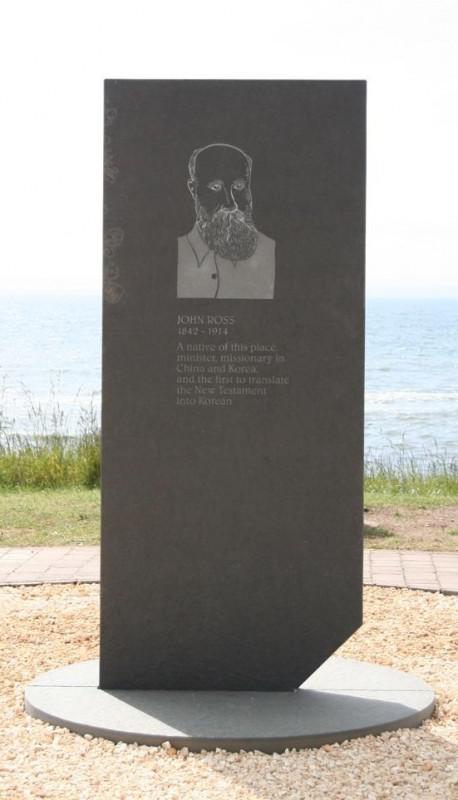
In 2009, a monumental plaque was erected in recognition of his life and pioneering missionary work, and his name is fondly remembered by the people of Balintore in the streets near where he grew up, e.g. “John Street’’ and “Ross Street”. John Ross’s lasting legacy is a Christian faith that embraces other cultures and renews hearts.
Shandwick Fossil Collection
Collected by David Alexander Vass, Balintore, 1986
The ammonite and belemnite fossils on display were found near the Well of Health (The Wellie), less than a mile from the end of Shandwick Bay.
Ammonites are a group of extinct marine molluscs closely related to octopuses, squid, nautilus and cuttlefish. The name “ammonite”, was inspired by the spiral shape of their fossilised shells, originating from the Egyptian god Ammon, who was typically depicted wearing ram horns. Belemnites are a group of extinct cephalopods, but unlike squid they had an internal skeleton. The hard bullet-shaped shell or guard is the most common fossilised remains.
Hugh Miller, the famous Scottish geologist, born at Cromarty in 1802, was the first person to write about these fossils, when he published “Testimony of the Rocks” in 1857 and “The Old Red Sandstone” in 1859. He was a prominent evangelical figure at the time of the Great Disruption, when over 450 ministers broke away from the Church of Scotland to form the Free Church of Scotland in 1843, leaving evangelists to preach to the fishing communities in the only buildings available to them, including open-air herring stores and curing yards.
Grateful thanks to Tommy and Catherine Vass for donating the fossil collection
Leave A Message
Reach Us
Seaboard Memorial Hall Ltd
East Street, Balintore, Highland, IV20 1UA
01862 832888
Company Ltd by Guarantee SC217924 & Scottish Charity SC025484